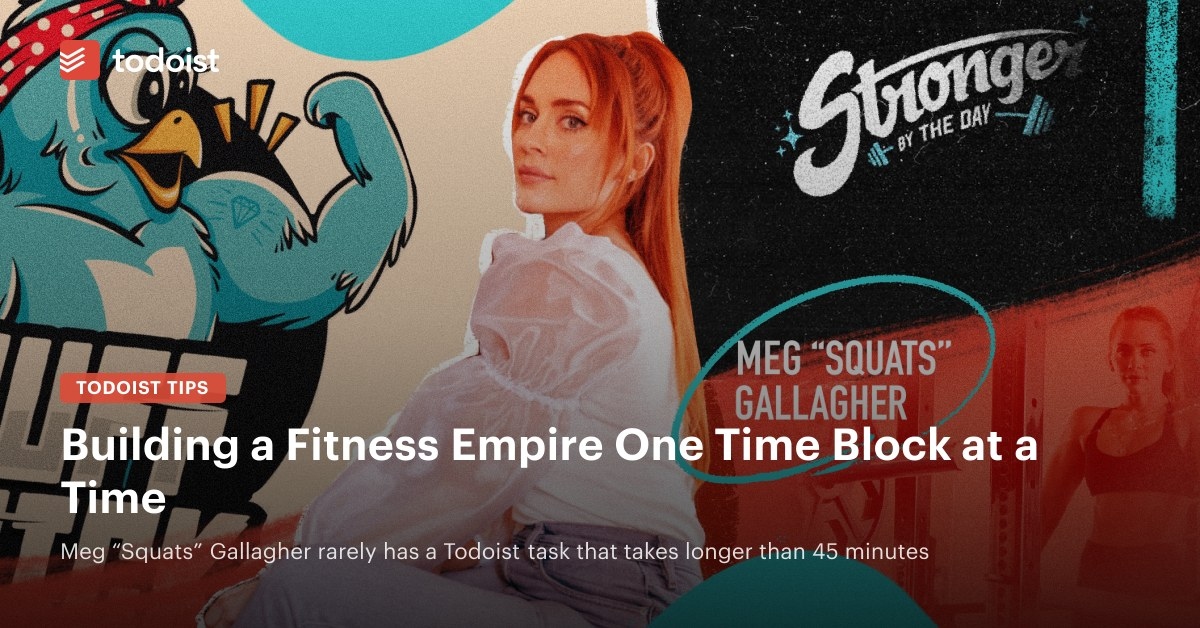
Meg Gallagher did not stumble into becoming a fitness influencer. Known online as @megsquats, she deliberately combined an interest in social media with an underserved focus: strength training for women. Her mission is to put a barbell in every woman’s hands—and time blocking helps her build the business behind it.
After briefly pursuing bodybuilding while sharing her fitness journey, Gallagher committed to strength training. She has competed nationally in powerlifting and coached tens of thousands of athletes, from first-time squatters to national-level competitors. Tracking measurable gains in strength boosted her confidence and shifted her attention away from appearance.
Her Instagram and YouTube audiences helped her develop Strong Strong Friends. Its offerings include the membership-based Stronger by the Day lifting program, with at-home bodyweight options; the 8-week Before the Barbell beginner course; nutrition courses and coaching; and the strength supplement line Buff Chick.
After becoming pregnant late the previous year, she began researching strength training through each trimester and the return to training after birth. At the time of the interview, she was developing a pre- and post-partum program to support safe training during pregnancy and recovery, while documentingthe details ofher own experience online.
Gallagher described how she organizes that work: breaking major projects into tasks lasting 45 minutes or less, scheduling every task, and using a timer to overcome procrastination.
A later start, with sleep protected
Gallagher starts work between 10:30am and 11:00am. Although she finds it difficult to shake the belief that early risers are more productive, getting enough sleep remains a priority.
Most days involve desk work and meetings. Fridays are reserved for filming, with the content planned and written beforehand. Depending on the video, she may read from a teleprompter, demonstrate exercises, or bring viewers through her day in a YouTube vlog.
Outside video production, she develops training programs. Her pre- and post-natal project involves writing workouts and consulting other professionals to check her decisions. The supplement company, launched in November 2020, also requires attention to label design, approvals, FDA font-size requirements, and other details.
When everyday life overlaps with content
Lunch often includes cooking something she can share with followers to discuss nutrition or offer a recipe. She does not regard that as work in the same way as desk tasks. Instagram stories, her preferred way to communicate, feel informal and conversational.
She allows herself breaks rather than staying at her desk all day. Sharing decisions about workouts, meals, and grocery shopping gives her ways to help followers through personal experience. Although constantly considering social media can feel awkward, she enjoys how it encourages her to try things outside her comfort zone.
Gallagher describes training three days during the week, alongside her dedicated Friday filming day. On two weekdays, she meets her brothers and father at 6:00 PM to train; they also share a more relaxed workout on one weekend day.
Her family follows Stronger by the Day, so she may share their progress or record her own training. Even when those posts promote the program or answer audience questions, she does not put them in Todoist or count them as conventional work. Enjoying the meals and workouts themselves helps sustain her interest in sharing what she learns.
Use Mondays to plan the week
Gallagher tries to concentrate meetings on Mondays, leaving the middle of the week available for larger projects. With Todoist open, she and her partner and fiancé review the different businesses and decide what needs to happen.
At the time of the interview, their sprint focused on finishing the pre- and post-natal program, followed by a second nutrition course covering macronutrients and advanced approaches to fat loss, weight loss, or muscle gain.
With a July due date, she wanted to complete substantial work in the first half of the year. Fully stepping away for maternity leave did not seem possible as a business owner, but she hoped advance preparation would give her, the team, and the business more flexibility.
An Excel sheet holds the master plan across the businesses. Todoist turns those larger commitments into manageable work. During the often lengthy Monday meetings, she effectively assigns her week, then tries to finish the small but important tasks immediately so they will not distract from midweek project work.
Turn weekly goals into short calendar blocks
Every task receives a due date and time. Gallagher subscribes to her Todoist calendar feed in Apple Calendar, allowing her to see the day’s schedule at a glance.
Rather than assigning herself an entire training program to finish in one day, she divides it into smaller pieces. Pregnancy provides a trimester structure, while strength programming commonly uses mesocycles—four-week training blocks. She might schedule writing trimester 1.1, the first block of the first trimester, and then work on 1.2 in the next hour.
This changes a daunting six-hour project into individual tasks of 30 minutes or 45 minutes. She puts her intended time estimate in each task name, assigns a scheduled time, and syncs Todoist with iCal. Looking at a series of time blocks feels more approachable than confronting the whole weekly goal.
Todoist also offers integrations for Google Calendar and Outlook.
A flexible Pomodoro timer helps her begin
Gallagher syncs Todoist with Flat Tomato, a Pomodoro app, to make starting easier. Committing to 25 minutes away from YouTube feels manageable, even when beginning a project does not.
She often continues working when the timer signals a break. While she acknowledges that she might benefit from a longer work interval, the timer still keeps her attention on one task and makes her aware of how long she has been sitting. Sometimes she postpones a break briefly; other times she skips it until the next round.
One choice can put you back on course
Gallagher applies a similar perspective to setbacks in fitness. Missing a workout or making a choice that does not support a goal need not define what follows. Her advice is to remember that the next decision can put you back on track.
This interview with Meg Gallagher was edited and condensed.

Becky Kane writes and edits from her home office in Minneapolis, USA, where she also tries to put her own productivity advice into practice.