A consistent review framework helps managers evaluate results fairly, explain expectations, and turn feedback into development plans. Without that structure, assessments can depend too heavily on individual impressions, leaving employees uncertain about how to improve.
Employee review templates establish shared criteria while allowing teams to adapt evaluations to different roles and review cycles. Combined with regular feedback, they also give HR and leadership more useful performance records.
What is an employee review template?
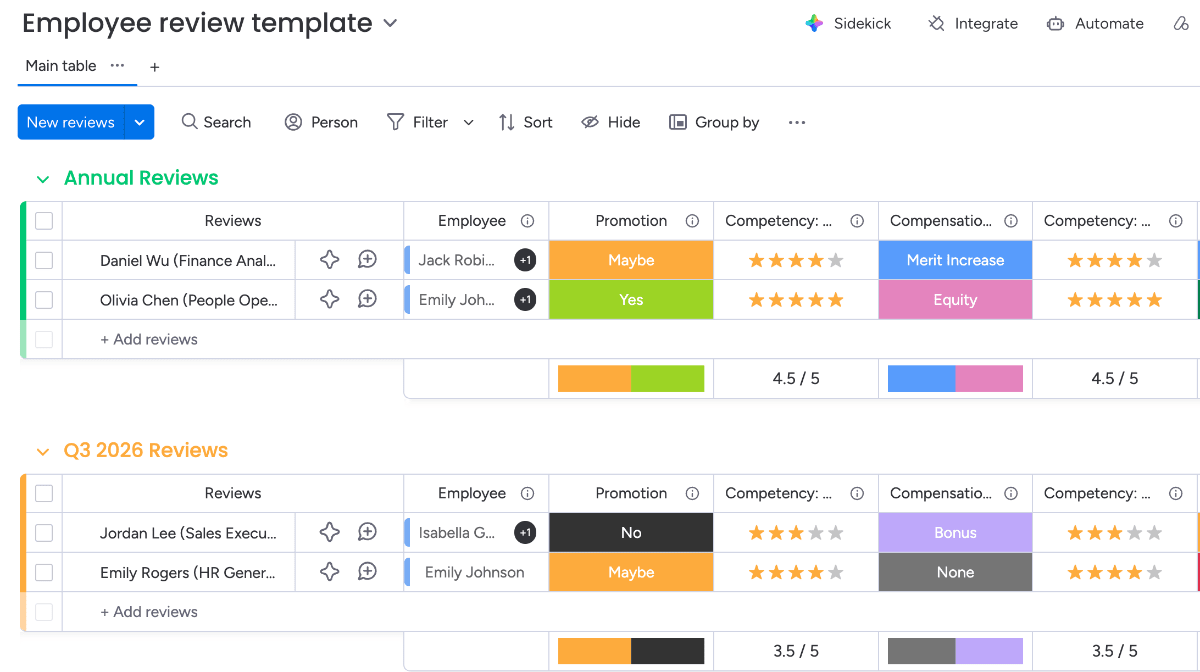
An employee review template is a structured document for assessing performance, recording accomplishments, and planning development. Its purpose is to give managers a common framework and employees constructive feedback based on consistent criteria. That consistency matters: research indicates that 72% of workers do not trust their organization’s performance management process.
Templates help prevent managers from overlooking important areas or applying different standards. They turn individual impressions into documented assessments that employees can understand and HR can track.
Performance review terminology
- Performance evaluation: The ongoing assessment of an employee’s job performance.
- Performance appraisal: A formal assessment documented at regular intervals.
- Review cycle: The frequency of evaluations, such as monthly, quarterly, or annually.
- Continuous feedback: Real-time exchanges about performance between managers and employees, rather than feedback reserved for scheduled reviews.
- OKR-based review: An assessment tied to objectives and key results (OKRs), connecting individual work with company goals.
Eight employee review template formats
The right format depends on what you need to assess. A new hire’s onboarding progress calls for different questions and data than a full year of established performance.
Annual performance review
An annual template brings together twelve months of results. Include major achievements, challenges addressed, goal completion rates, and future objectives to support the broader performance management strategy.
Quarterly performance review
Quarterly reviews concentrate on recent accomplishments and progress toward annual goals. Their shorter scope makes it easier to adjust direction before smaller difficulties become significant problems.
90-day employee review
A new hire review examines onboarding, early performance, cultural adaptation, initial responsibilities, and team integration. A new hire form can support data collection, while a structured 30-60-90 day plan provides a complementary framework for early development.
Employee self-evaluation
Self-assessments give employees a direct role in reviewing their progress and identifying development needs. They encourage ownership and help make the review a two-way discussion. Start with specific accomplishments and measurable results, then identify areas for growth.
- Achievements: Record milestones and individual contributions.
- Development opportunities: Identify skills or aspects of performance to strengthen.
- Future goals: Describe practical steps for continued progress.
360-degree feedback
A 360-degree review draws on managers, colleagues, direct reports, and sometimes clients. Together, their perspectives reveal collaboration skills, leadership effectiveness, and working relationships.
Provide separate sections for manager assessment, peer evaluation, direct report input, and self-assessment. Distribute role-specific questionnaires using a shared rating scale, establish completion deadlines, and combine responses into a summary that identifies recurring patterns.
Continuous performance review
Brief, focused templates capture feedback as work happens instead of waiting for scheduled evaluations. They suit fast-moving environments, particularly when performance management software supplies real-time data.
Goal-based performance review
This format measures achievement against specific objectives rather than general competencies. It suits sales, project management, and other roles with quantifiable targets, and can work alongside an action plan template for goal setting.
Peer evaluation
Peer reviews focus on teamwork and collaboration. Colleagues can identify supportive behaviors and team dynamics that managers may not directly observe.
What every employee review form should include
- Employee and review details: Record the employee’s name, role, department, review period, and evaluating manager.
- Performance measures: Use numerical scales, descriptive ratings, or percentage-based scores appropriate to the organization. Apply measures consistently to support fair comparisons across roles and periods.
- Professional development: Identify skills to build and use a needs analysis to establish training priorities. monday.com’s AI Work Platform can track development activities and connect them with measurable outcomes.
- Both perspectives: Include manager feedback and employee input so the discussion supports trust and practical decisions.
- Goal tracking: Compare earlier objectives with current results, then establish new targets. Employees who understand how success is measured are more than twice as likely to feel motivated.
How to select a suitable template
Account for company size and structure
Smaller organizations often need simple, flexible forms because one employee may cover several responsibilities. Large organizations need greater standardization to evaluate hundreds of employees consistently across departments and make useful comparisons.
Reflect the organization’s culture
- Formal workplaces may need detailed criteria and comprehensive documentation.
- Collaborative, fast-moving teams may prefer conversational formats that accommodate ongoing feedback.
- Organizations with strong value-based priorities can assess innovation, teamwork, or customer success explicitly.
The AI Work Platform offers customizable fields, dynamic layouts, and connected workflows so teams can reflect these differences while retaining common standards.
Keep the scope appropriate to the review cycle
Annual forms should address long-term patterns; quarterly forms should emphasize recent progress; monthly check-ins should stay brief and cover immediate concerns. Match complexity to the time managers can realistically devote to reviews. Detailed forms used too frequently can encourage rushed, superficial responses.
Include industry requirements
- Healthcare: Patient safety measures and compliance requirements.
- Financial services: Risk management and regulatory adherence.
- Technology: Innovation and technical skills.
- Retail: Customer service scores and sales results.
Incorporate these requirements when designing the template rather than adding them later.
Why standardization matters
Compliance and legal documentation
Applying the same criteria creates records of fair treatment and helps protect against discrimination claims. Templates provide an audit trail of objective, job-related assessments.
Comparable performance data
Consistent records let leaders compare teams, recognize trends, and make better-informed promotion and development investment decisions.
Support for new managers
Only about a quarter of organizations say their leaders are highly skilled at enabling team performance. Templates help managers learn which questions to ask, how to apply assessment criteria, and how to make feedback useful.
Visible employee development
Structured records make it possible to follow skill development, identify training needs across departments, and evaluate development programs. A visible growth path also supports retention.
Workforce planning insights
Aggregated evaluations can reveal high-performing departments, shared skills gaps, and management practices associated with strong results. These patterns support strategic workforce planning.
Who benefits from review templates?
- HR and people operations: Standardized processes and compliance records reduce the administrative work of coordinating reviews at scale.
- Managers and team leads: A clear framework reduces preparation time and leaves more room for coaching.
- Executives: Combined data provides visibility into performance trends, talent gaps, and succession readiness without requiring a review of every individual report.
- Project teams: Linking contributions to delivery goals helps recognize achievements and address skills gaps within a project cycle.
- Remote and hybrid teams: Shared criteria support consistent assessments when direct observation is limited and collaboration is asynchronous.
How to run an effective performance evaluation
Step 1: Gather objective evidence
Before the meeting, collect project results, goal metrics, and peer feedback. Keep examples throughout the entire review period rather than relying on recent events.
Use measurable evidence instead of broad labels. For example, document that an employee led weekly meetings that reduced project delays by 20%, rather than simply describing them as a good communicator.
Step 2: Discuss specific examples
Connect feedback with identifiable situations. Pointing to strategic thinking demonstrated in a board presentation on March 15th is more useful than assigning a general strategic label. Discuss behaviors and outcomes, not personality traits.
Step 3: Make room for dialogue
Ask employees to explain their experience through open questions:
- Which achievements matter most to you?
- What challenges were hardest to address?
- What support would make success easier?
Listen carefully and use their input when shaping development plans.
Step 4: Agree on measurable actions
Translate feedback into SMART goals. Instead of a broad customer service improvement goal, specify completion of advanced customer service training by December 30th, 2026, and achievement of 90% satisfaction scores in Q4.
monday.com’s AI Work Platform can connect these actions with daily work and track progress between reviews.
Step 5: Maintain follow-up
Arrange monthly check-ins and use short templates to review progress. Consistent follow-up demonstrates commitment to development and reduces unexpected issues at year-end.
Performance review mistakes to avoid
Giving recent events too much weight
A difficult final month should not overshadow 11 strong months. Record performance regularly and use quarterly milestone tracking to keep the whole period in view.
Rushing preparation
Last-minute assessments often miss important details and produce generic feedback. Reserve preparation time in the calendar; a structured template can make that time more efficient.
Applying one generic form to every role
Sales and engineering require different performance criteria. Create variations for major job families while retaining the same core structure.
Discussing only weaknesses
Unbalanced criticism can undermine motivation, including among strong performers. Begin with achievements, then address development constructively. Use a performance improvement plan template where necessary.
Leaving out next steps
Give development actions their own section, with deadlines and success measures. Without those details, employees may leave unsure of priorities.
Excluding the employee’s perspective
Employees can explain challenges and suggest solutions managers have not considered. Include self-assessment in every template to capture that context.
Waiting until the next annual review
Annual-only feedback can allow problems to persist and increase anxiety. Use simplified forms for monthly or quarterly conversations between formal evaluations.
Managing reviews with monday.com's AI Work Platform
monday.com’s AI Work Platform combines templates, automation, AI-powered insights, and real-time collaboration in a connected review process, reducing reliance on separate spreadsheets, emails, and forms.
The platform is recognized as a Leader in the 2025 Gartner Magic Quadrant. A Forrester Total Economic Impact study reports a 346% ROI over three years.
Adaptable review workflows
Teams can create role-specific templates, choose review cycles, and configure approval paths around their organizational structure. Those workflows can change as the organization develops without rebuilding the process from scratch.
AI support for evaluation preparation
The platform’s AI features support human judgment by handling summaries and pattern detection. AI Blocks can:
- Condense lengthy project updates into achievement summaries.
- Detect sentiment patterns that may signal engagement concerns before performance is affected.
- Identify development themes shared across teams.
- Sort feedback by theme, urgency, or department.
monday sidekick is a context-aware assistant within the workspace. It helps managers draft summaries and development plans and retrieve action items from earlier feedback. monday agents extend automation: the Sentiment Detector agent tracks feedback trends in real time, while the Onboarding Helper agent supports structured 90-day reviews.
These capabilities aim to reduce preparation work and improve feedback quality. The article’s cited finding that 80% of Millennials say AI helps them do their jobs with greater impact reflects the value employees place on such support.
Shared manager-employee context
Managers and employees can update goals, record achievements, and follow progress together. Workdocs pulls live board data into collaborative review documents, keeping discussions connected to actual work. This shared context helps both participants prepare and can make formal reviews less stressful.
Connections with HR systems and AI tools
APIs and pre-built integrations connect the platform with existing HR systems. Teams can synchronize employee information, send review results to payroll, and connect development plans with learning platforms, reducing duplicate entry.
monday MCP connects the workspace to Claude, ChatGPT, and Copilot for querying performance data or drafting review content. monday.com’s AI Notetaker automatically captures and summarizes review meetings and creates action items directly on monday.com.
Connected workflows versus manual reviews
Spreadsheets and documents require manual updates, version management, and follow-up. The AI Work Platform automates those tasks while adding real-time visibility, collaboration, and AI-supported insights.
| Capability | Spreadsheets/docs | The AI Work Platform |
|---|---|---|
| Template customization | Manual formatting, version control issues | Drag-and-drop fields, role-specific templates saved and shared instantly |
| Automated reminders | Manual calendar invites or email follow-ups | Built-in automations trigger notifications based on dates, statuses, or conditions |
| AI feedback analysis | Not available | AI Blocks summarize, detect sentiment, extract themes, and categorize feedback |
| Multi-source feedback | Separate forms collected manually | 360-degree feedback gathered and consolidated in one workspace |
| Real-time tracking | Static snapshots, outdated by the time reviews happen | Live dashboards showing goal progress, completion rates, and team performance |
| Integration with HR systems | Copy-paste between systems | Pre-built integrations sync data with payroll, HRIS, and learning platforms |
Features for tracking reviews across teams
- Dashboards: Monitor performance trends, review completion, and goal progress in real time. Filter results by department, manager, or cycle.
- Automations: Send reminders, update statuses when evaluations arrive, and notify stakeholders when reviews are finished.
- monday vibe: Build custom apps without code, including an Employee Resource Portal or organizational chart. HR teams can create onboarding, review tracking, or OKR monitoring experiences in minutes.
- Workdocs: Bring live board data into shared documents so employees and managers can contribute together.
- Templates: Adapt ready-made forms, fields, workflows, and approval steps without rebuilding them every cycle.
A useful review process combines templates suited to the team, regular conversations, and visible follow-through. Keeping performance information connected helps turn evaluations into ongoing development rather than an isolated annual exercise.
Frequently asked questions
How frequently should employee reviews take place?
Combine a comprehensive annual evaluation with monthly or quarterly check-ins. This keeps goals aligned, surfaces difficulties earlier, and gives the formal review more context.
Is a performance appraisal form different from a review template?
They are essentially the same document: both structure an assessment of employee performance. Some organizations use the more formal term appraisal, but the content and purpose are identical.
Can templates be adapted for remote employees?
Yes. Include measures for virtual collaboration, communication effectiveness, and self-management to reflect distributed work.
Which rating scale works best?
A three to five point scale offers useful differentiation without the confusion or grade inflation that larger scales often introduce.
How should an employee review be written?
Collect specific, measurable examples from across the review period. Organize quantitative results and qualitative observations around achievements, development needs, and SMART goals for the next cycle. Leave room for the employee’s perspective.
What does useful positive feedback look like?
Connect praise to observable actions and results. Examples could recognize an employee for creating a structured training guide that reduced onboarding time by 30%, providing weekly status updates that kept a product launch team aligned, or mentoring 2 junior colleagues who both exceeded their Q2 targets.
Can AI assist with writing reviews?
AI can summarize feedback from multiple sources, identify sentiment trends, and draft initial language from documented performance information. On monday AI Workspace, AI Blocks and monday sidekick help generate summaries, detect engagement patterns, and surface development recommendations, reducing preparation time while supporting better feedback.