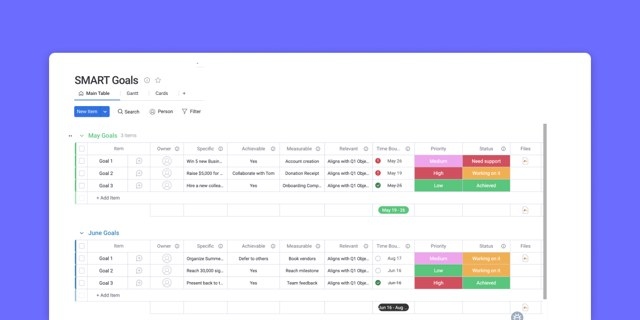

When teams begin Monday with competing priorities and unfinished work, effort can fail to translate into visible progress by Friday. Weekly goals give that effort a shared direction: a seven-day window for meaningful outcomes, coordinated work, and timely adjustments.
Key principles for weekly planning
- Keep the list to 3–5 weekly goals so attention and quality do not suffer.
- Connect each goal to quarterly objectives or broader strategic priorities.
- Check progress mid-week to uncover blockers while there is still time to respond.
- Give every goal one accountable owner while sharing responsibility for delivery.
- Use shared systems, such as monday.com, to make progress, workloads, and dependencies visible.
What weekly goals mean for teams
A weekly team goal is an outcome to achieve within seven days. It connects everyday assignments with monthly targets and gives collaborators a common planning rhythm. Unlike a personal checklist, it depends on coordinated contributions and clear accountability.
Strong weekly goals combine three qualities:
- Specific outcomes: Everyone understands what completion will look like.
- Shared contribution: Several people work toward the result.
- Strategic relevance: The outcome supports a wider business objective.
This approach turns strategy into practical work without making the plan too rigid to accommodate changing priorities.
From individual checklists to shared outcomes
Separate task lists can hide progress and leave people unsure how their assignments connect. Shared goals expose those connections early. Marketing might depend on design assets, for example, while operations needs input from finance.
On monday.com, shared boards display these relationships, and automatic updates help prevent missed handoffs. The differences between individual and team approaches are outlined below.
| Individual approach | Team weekly goals |
|---|---|
| Tasks live in personal notebooks or apps | Goals visible to the entire team |
| Success is measured by items checked off | Success is measured by outcomes achieved |
| Dependencies discovered mid-week | Dependencies mapped upfront |
| Progress updates happen in meetings | Progress visible in real-time |
Why use a seven-day cycle?
A week provides enough time for substantial work while keeping deadlines close enough to sustain urgency. Longer planning windows can encourage overcommitment; overlooking complexity can also slow execution.
- Monday provides a natural point to plan and prioritize.
- Mid-week reviews reveal problems before they grow.
- Friday offers an opportunity to close work and recognize results.
This rhythm supports momentum without burnout and creates 52 opportunities a year to adjust, rather than twelve with monthly reviews. Short, outcome-focused sprints serve a similar purpose for agile teams.
3 advantages over managing daily tasks alone
Weekly planning changes the central question from what needs doing today to which outcomes matter most this week. Daily assignments still matter, but they serve a shared result rather than becoming an end in themselves.
1. Clearer focus and stronger productivity
Agreeing on priorities helps people understand where to concentrate and how their work affects colleagues, reducing task-switching and wasted effort. Without that alignment, marketing might run campaigns while product is still finishing features and support is left catching up. Shared launch milestones allow all three teams to coordinate instead.
monday.com supports this through linked departmental goals, notifications when dependencies are completed, and shared progress dashboards.
2. Earlier cross-functional collaboration
A weekly planning conversation gives teams time to request what they need, such as sales collateral from marketing, before a deadline becomes urgent. Clear goals reduce assumptions, surface problems sooner, and make results something teams can celebrate together.
3. Better insight into capacity
A shared weekly plan shows the work already underway, helping managers distribute assignments without creating bottlenecks or overloading people. During planning:
- Check availability before adding work.
- Confirm that the necessary resources exist before promising a deadline.
- Balance assignments to maintain a sustainable pace.
Workload views on monday.com automate this visibility and help teams avoid excessive commitments.
Choosing the right number of weekly goals
Too few objectives can leave capacity unused; too many can undermine quality and completion. For most teams, three to five weekly goals provide a workable balance.
A short list allows deeper attention, supports higher standards, and makes priorities easier to remember and discuss. The appropriate number still depends on team size, structure, and the complexity of the work.
Adjusting for team size
Small teams generally need tighter focus. Larger groups can distribute responsibility among smaller units, with broad goals broken into practical sub-goals.
| Team size | Recommended goals | Approach |
|---|---|---|
| Small (3-5 people) | 2-3 goals | Focus on one major initiative at a time |
| Medium (6-12 people) | 3-5 goals | Balance across functional areas |
| Large (13+ people) | 3-5 umbrella goals | Break down into sub-team deliverables |
For example, a department of 20 people could choose four weekly goals and assign one deliverable to each five-person team.
Combining reliable wins with stretch goals
Use a 70/30 balance to combine progress with development:
- 70% achievable goals to sustain confidence and momentum.
- 30% stretch goals to encourage learning, innovation, and growth.
This mix helps avoid both stagnation and burnout.
5 steps for setting effective weekly team goals
A repeatable process turns strategic intentions into clear commitments and gives the team a consistent way to learn.
Step 1: examine the previous week
Review completed and missed goals, then investigate why results differed. Look for patterns rather than blaming individuals.
- Completion: Which types of goals regularly succeed or stall?
- Resources: Where did time and effort go?
- Obstacles: What prevented or delayed progress?
monday.com dashboards highlight trends and recurring bottlenecks, giving the discussion a basis in data.
Step 2: specify measurable outcomes
Replace broad ambitions with clear deliverables. For example, resolving 90% of support tickets within 24 hours gives the team more direction than simply improving customer satisfaction.
Each goal should explain:
- What the team will deliver.
- Which criteria will demonstrate completion.
- Which stakeholders or customers will benefit.
A goal-setting template can keep these details consistent and maintain attention on results.
Step 3: give one person ownership
Choose a champion for each goal. This person coordinates contributions, addresses roadblocks, and keeps delivery moving; they are not expected to do everything alone.
- Make one person accountable for the outcome.
- Give that owner responsibility for communication and dependencies.
- Verify that they have sufficient capacity before assigning the goal.
Resource management features on monday.com help teams check availability before making commitments.
Step 4: schedule a mid-week checkpoint
Hold a brief review, usually on Wednesday or Thursday, to solve problems rather than merely report status. Ask whether goals remain on track and what help is needed. Acting on these answers avoids waiting until Friday to discover a preventable delay.
Step 5: confirm the link to quarterly priorities
Before approving the plan, check that every goal advances a quarterly objective. Remove goals that do not support a larger priority so everyday effort contributes to company progress.
Linking weekly work with company OKRs
On monday.com, teams can connect weekly goals with OKRs and strategic initiatives, making the relationship between daily assignments and company objectives visible.
Translate strategy into weekly actions
Break annual objectives into quarterly key results, monthly milestones, and weekly goals. Each level should support the one above it. An annual objective to expand market presence could become:
- Quarterly key result: Enter three new regions.
- Monthly milestone: Finish regional market analysis.
- Weekly goal: Interview ten customers in the target region.
Linked boards and portfolio views on monday.com show how these smaller commitments contribute to larger outcomes.
Coordinate dependencies across functions
Product launches, campaigns, and financial planning often require several departments. To manage these connections, make current work visible, establish channels for early coordination, and specify handoffs and deadlines. Weekly goals provide a shared framework for these conversations and reduce unexpected delays.
Measure the contribution to key results
Completion alone does not show strategic value. Connect weekly goals with quarterly KPIs and measurable business outcomes. Generating 50 qualified leads through an email campaign provides a stronger link than simply launching the campaign: it connects the activity to measurable revenue impact.
Monitoring and improving weekly performance
Follow-through requires current progress information, an understanding of recurring patterns, and changes based on the evidence.
Use real-time dashboards
Unlike static reports that may be outdated before review, live dashboards show progress, capacity, and emerging risks. Include both:
- Leading indicators, such as completed tasks, time invested, and identified blockers.
- Lagging indicators, such as achieved goals, quality measures, and business impact.
Together, these measures give a fuller view of team performance. monday.com reporting gathers the information automatically, reducing manual compilation and supporting decisions with current data.
Keep weekly reviews focused
Limit review meetings to under 30 minutes and organize them around learning:
- Which successes should the team repeat?
- What obstacles slowed delivery?
- What should change next week?
This keeps reviews useful without making tracking an additional burden.
Adjust commitments using historical results
Repeatedly missing goals may indicate overcommitment, while completing everything every week may suggest insufficient challenge. Aim for an 80–90% achievement rate.
Use past results to refine goal complexity, improve scheduling, and understand the resources different activities require.
How AI can help teams achieve weekly goals
Beyond recording progress, AI can forecast likely outcomes and suggest next actions, helping teams respond before problems become urgent.
Recommend goals based on delivery pace
AI uses historical completion rates, seasonal patterns, and individual workloads to estimate next week’s capacity and recommend suitable goal volume and complexity.
AI blocks on monday.com can:
- Sort incoming requests by urgency and strategic importance.
- Extract essential requirements from project briefs.
- Suggest priorities that fit strategic objectives.
These capabilities help distinguish important work from requests that merely appear urgent.
Track progress automatically
Manual updates take time and can leave information behind reality. Continuous AI monitoring can recognize slowing delivery or increasing blockers before people notice a goal drifting off course.
- Pattern recognition identifies repeated problems across similar goals.
- Risk prediction warns of possible missed deadlines.
- Resource optimization suggests ways to rebalance workloads.
Use forecasts to refine priorities
By considering dependencies, available resources, and historical patterns, AI forecasts which goals are likely to succeed and which need intervention. Teams can then shift capacity toward at-risk goals, identify potential bottlenecks, and revise timelines to reflect actual capacity.
Product Power-ups on monday.com surface these insights automatically to support proactive decisions.
What customers say about monday.com
Project Manager Kendra Seier describes monday.com as life-changing, citing transparency, accountability, and a central place for managing projects worldwide.
Chief Operations Officer Duncan McHugh describes it as the connection between the support office and stores, providing visibility to move quickly, maintain consistency, and understand revenue impact.
Managing weekly goals with monday.com
monday.com brings weekly planning, shared progress information, and strategic alignment into one system. Its capabilities include:
- Goal visibility that connects individual assignments and weekly outcomes with company objectives.
- Automated tracking of completion, blockers, and resource use.
- Workload balancing to expose capacity gaps and potential overload.
- Shared boards and synchronized timelines for cross-team dependencies.
- AI insights for anticipating risks, recommending priorities, and allocating resources.
Frequently asked questions
What does a weekly goal look like?
One example is interviewing ten customers for user research and turning the findings into actionable product recommendations by Friday. It defines a measurable, time-bound result that requires collaboration.
How should weekly goals be written?
Use the SMART criteria: specific, measurable, achievable, relevant, and time-bound. Identify an owner and success criteria, ensure the work fits within seven days, and connect it to broader objectives.
How do weekly goals differ from daily tasks?
A weekly goal describes the outcome due by the end of the week. Daily tasks are the individual actions needed to achieve it.
How many goals should a team choose each week?
Most teams benefit from three to five. This keeps meaningful progress possible without splitting attention across too many priorities.
What is the best way to monitor progress?
Use live dashboards for completion status, resource allocation, and blockers. Combine automated reporting with mid-week checkpoints to identify goals at risk without relying on manual updates.
When is a mid-week change appropriate?
Revise goals when new information substantially changes priorities, outside factors make the original outcome impossible, or necessary resources become unavailable. Record the changes so recurring patterns can inform future planning.